Delivered August 8, 2026 · Fallston, Maryland
Sibby
Sibylle Eleanor Patrick
Our first Toddler Mobility Trainer went home with a very determined four year old. This is her story, told by the person who knows it best.
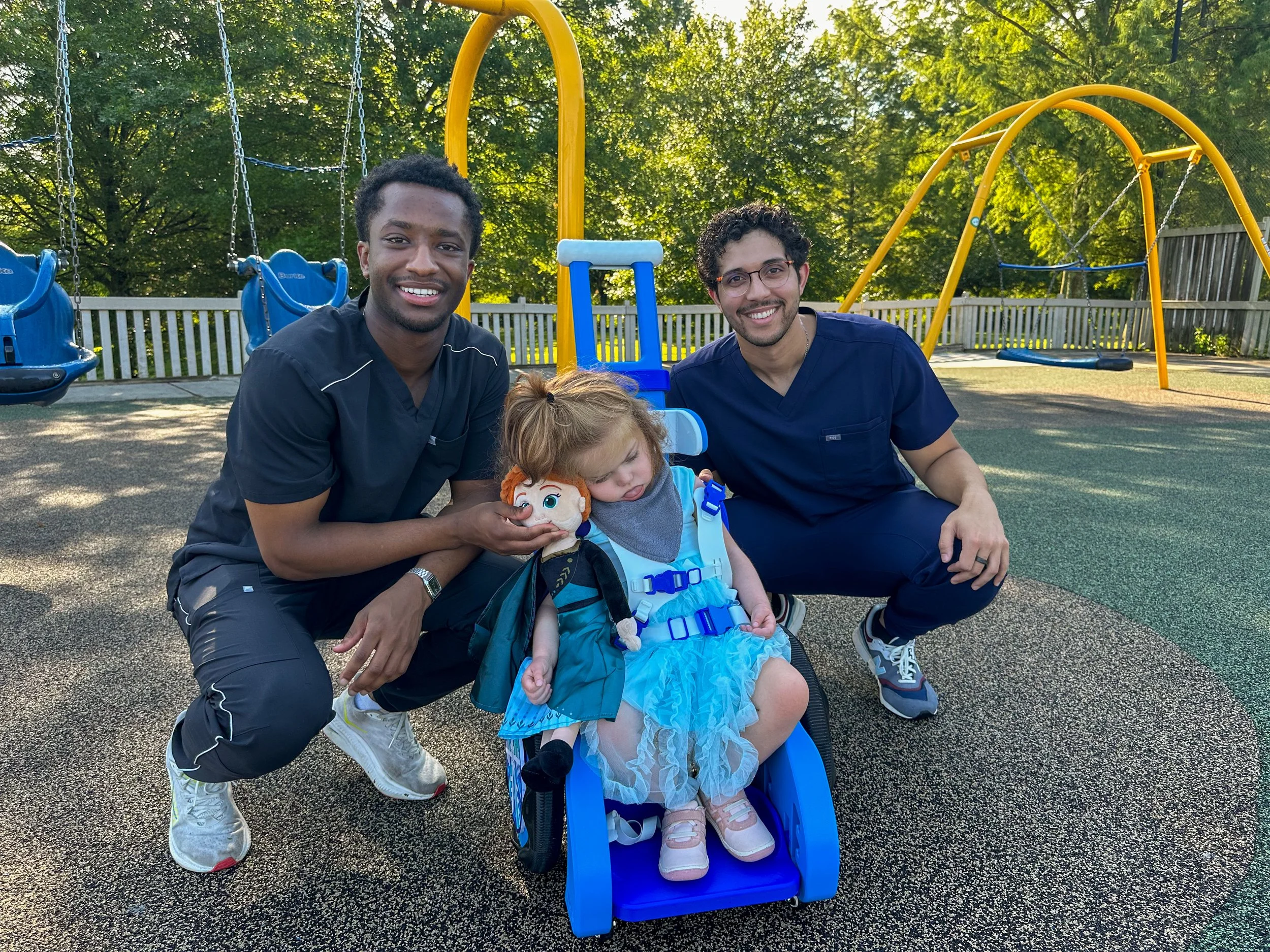
Sibby's TMT is Frozen themed: snowflake wheels, royal blue, and a lot of sparkle. So this page is too.
- Who
- Sibby, age 4
- Device
- Toddler Mobility Trainer
- Where
- Darlington, Maryland
- Built by
- EcoPrint
Meet Sibby
Sibylle Eleanor Patrick, but everyone knows her as Sibby
Sibby has two big brothers, Emmett and Nolan, who absolutely adore her. She is happy, sassy, loving, determined, and incredibly expressive. She experiences the world differently than most children, but she has no trouble letting people know what she likes, what she does not like, and exactly how she feels about it.
She loves music, being outside, bubbles, swimming, and especially her brothers. She has the sweetest smile, the best giggle, and a personality that can light up a room.
In her mother's words Sibby's story, told by her mom Written by Jen Patrick, August 2026. Condensed, about a five minute read.
Our family has learned to appreciate moments that might otherwise be easy to overlook: hearing Sibby laugh, watching her enjoy the breeze on a summer day, seeing her splash in the pool, or watching the excitement on her face when she is surrounded by the people she loves. Those moments mean everything to us.
Our journey with SCN8A
Sibby was born in August 2022. Every prenatal test and scan gave every indication that we were expecting another healthy baby. By the spring, though, we knew something was not right. On April 12, 2023, we brought her to the Johns Hopkins emergency department after seeing an unusual episode. Her head suddenly twitched, her eyes opened wide, her arms shot out from her sides, and she cried in fear afterward. Then it happened again. And again.
Doctors diagnosed her with infantile spasms. At the worst point, we estimated 50 to 60 seizure clusters in a single day. What followed was more than a year of specialists, hospital visits, testing, medications, therapies, and uncertainty. Eventually, a second opinion at Children's Hospital of Philadelphia gave us an answer: SCN8A-related disorder. As far as we know, Sibby is currently the only known individual with her exact genetic variant.
Having an extraordinarily rare diagnosis means there is not always a roadmap. There is no book that tells us exactly what Sibby's future will look like.
“We have had to learn to stop measuring Sibby against what children are supposed to be doing, and instead celebrate what Sibby is doing.”
Jen Patrick
Why mobility matters
For many families, a wheelchair might initially look like a symbol of limitation. For us, it means almost the exact opposite. A wheelchair represents access, participation, comfort, independence, and opportunity. It allows the world to come to her eye level rather than requiring her to always be carried or positioned separately.
Sibby recently received her first custom medical wheelchair. We chose hot pink, because obviously every girl needs a Barbie Dream Car. But as wonderful and necessary as it is, we also wanted Sibby to have other options, something lighter and easier to take into places where a large medical wheelchair may not always be practical.
Finding MakeGood and EcoPrint
Our introduction to MakeGood happened almost completely by accident. At an end of the year celebration at Sibby's school, I overheard one of her therapists talking with another child's parents about the mobility devices they were providing for children. I was not even part of the conversation. But I was listening. And like so many things on this journey, a conversation we were not originally part of suddenly opened another door for Sibby.
We applied through MakeGood and were thrilled when EcoPrint reached out and told us they had claimed Sibby's build. From that very first message, it was obvious that they did not simply want to manufacture a TMT and send it to us. They wanted to build Sibby's TMT. And there is an important difference between those two things.
Designing something for Sibby
One of the first questions EcoPrint asked was what colors and themes Sibby might enjoy. Frozen immediately came to mind, and we suggested royal blue, light blue, white, and silver. But as the conversation continued, they did something we really appreciated. They started asking questions about how Sibby experiences the world.
In addition to her developmental disability, Sibby has cortical visual impairment, or CVI. Because of the way her brain processes visual information, she may not recognize a character the same way another child might. What she does respond to are bright, bold colors, strong contrast, simple visual elements, and things that sparkle or shimmer. EcoPrint's response was essentially: we will figure out how to make that work. And they did.
“They were no longer simply decorating a mobility device around a theme. They were designing it around Sibby.”
Jen Patrick
Watching it come together
They brought us along for the build. They messaged us when they ordered the filament and when printing began. Forty percent printed. Almost finished. Ready for assembly. They even created a small scale replica of Sibby's TMT so they could show us ideas for the wheels before committing. Eventually we gave perhaps the least helpful design direction possible: honestly, surprise us. By that point, we trusted them.
Parents of medically complex children spend an incredible amount of their lives navigating systems: insurance companies, equipment vendors, authorizations, denials, approvals, and then usually a few more follow ups. Sometimes even obtaining something your child unquestionably needs can feel like a second job. This felt completely different. What impressed us most was how quickly the conversation changed from what should this TMT look like, to who is Sibby and how do we make this special for her.
The delivery
Rather than simply arranging a handoff, EcoPrint wanted the experience to happen somewhere our family could actually enjoy the device together. Together we chose Annie's Playground in Fallston, Maryland. Let Sibby enjoy her new TMT. Let Emmett and Nolan push their sister around. And capture our family doing exactly what we hope this device will make easier for us to do: experience things together.
That approach meant something to us, because it recognized an important truth about adaptive equipment. The purpose of the equipment is not the equipment itself. The purpose is everything the equipment makes possible. It is not about where Sibby cannot go. It is about all the places she can go.
Thank you for listening when we explained not simply what Sibby likes, but how she sees the world. Thank you for recognizing that snowflakes, sparkles, colors, and a little bit of personality really do matter.
Jen Patrick
Sibby's mom · Maryland
“Thank you for seeing Sibby before seeing her disability.”Jen Patrick, Sibby's mom
Delivery day
Annie's Playground, Fallston
August 8, 2026. Photographs shared with her family's permission.
- Build team
- Sibby's TMT was designed, printed, and assembled by Caleb DeBass, Jon Dawson, and Jake Lonergan.
The delivery film is coming soon
We filmed the build and the delivery at Annie's Playground. When it is finished it will live right here.
What it takes to put one kid in motion The numbers behind Sibby's build
- TMT
- MakeGood TMT kit
- The open source design we print from
- 250
- Hours printing
- Roughly, plus mockups and a scale replica
- $200
- In materials
- The full cost of the device
- $0
- Cost to the family
- Every device, every time
The whole letter
We asked Jen to tell it in her own words
She sent back far more than we expected. What you read above is the condensed version. The whole letter, at her pace, is here.
What happens next
There is another family already waiting
Sibby's build is finished. The queue behind her is not. Three ways to move it along.
One
Fund the next build
Our hours are volunteered and the files are free. What we buy is plastic and hardware. Gifts routed to EcoPrint through MakeGood go straight into the next device.
$200 covers one complete device
Sponsor a deviceTwo
Build one yourself
If you own a printer, you are most of the way there. The Toddler Mobility Trainer files are open on MakerWorld, the same ones we printed for Sibby.
Files are open and free to use
Get the filesThree
Know a family like hers
Jen found out about the TMT by overhearing a conversation at school. Most families never hear about it at all. Eligibility comes down to a sizing chart, and there is no cost and no insurance involved at any point.
No cost to the family, ever
How to request a deviceThank you to Jen, Evan, Sibby, Emmett, and Nolan for trusting EcoPrint with this one, and to MakeGood for the design and the network that made it possible.
Who made this build possible
Bambu Lab
Sponsored our first build with the filament and the printers that made Sibby's TMT.
FIGS
Supplies the EcoPrint team with the scrubs we wear on every build and delivery.
Sibby's story, in full
Written by Jen Patrick, August 2026Our daughter's name is Sibylle Eleanor Patrick, but almost everyone knows her as Sibby. She is the youngest of our three children and has two brothers, Emmett and Nolan, who absolutely adore her.
Sibby has a special way of drawing people in. She is happy, sassy, loving, determined, and incredibly expressive. She experiences the world differently than most children, but she has no trouble letting people know what she likes, what she does not like, and exactly how she feels about something. She packs an enormous personality into her little body.
She has the sweetest smile, the best giggle, and a personality that can light up a room. She loves music, being outside, bubbles, swimming, and especially spending time with her two big brothers. Emmett and Nolan treasure her and always find ways to include her in whatever adventure they are on.
Our family has learned to appreciate moments that might otherwise be easy to overlook: hearing Sibby laugh, watching her enjoy the breeze on a summer day, seeing her splash in the pool, or watching the excitement on her face when she is surrounded by the people she loves. Those moments mean everything to us.
Our journey with SCN8A
Sibby was born in August 2022. Throughout the pregnancy, every prenatal test, scan, and milestone gave every indication that we were expecting another healthy baby. We elected to do additional genetic testing because we have always been the kind of parents who want as much information as possible. No result would have changed how much we wanted or loved our child. We simply believed that information would allow us to be better prepared if an issue arose. Every test came back normal.
We lived in Hot Springs, Arkansas, when Sibby was born by planned C section at 39 weeks. She spent five days in the NICU because of rapid breathing after birth but ultimately needed little more than oxygen support and recovered easily. When she was just three weeks old, our family packed up and moved across the country to Darlington, Maryland, just north of Baltimore. We had purchased a small, run down farm property and began the adventure of turning an old house into our family's home.
During the winter of 2022 into 2023, we noticed that Sibby was not meeting her developmental milestones as expected. At first, it was difficult to know what was meaningful and what was simply normal variation between children. By spring, though, we knew something was not right.
On April 12, 2023, we brought Sibby to the Johns Hopkins emergency department after seeing an unusual episode. Her head suddenly twitched, her eyes opened wide, her arms shot out from her sides, and she cried in fear afterward. Then it happened again. And again.
During that hospitalization, doctors diagnosed Sibby with infantile spasms, a rare and potentially devastating form of epilepsy that begins during infancy. We learned very quickly that these seizures can be subtle and easy to mistake for normal infant movements, but uncontrolled infantile spasms can significantly affect a child's development. We also learned that infantile spasms could be the diagnosis, or they could be a symptom of something much larger. For a long time, we did not know which applied to Sibby, only that the seizures would not stop.
At the worst point in her seizure journey, Sibby experienced so many seizures and clusters that accurately counting them became nearly impossible. We estimated that she experienced 50 to 60 seizure clusters in a single day. As parents, we found ourselves watching our daughter constantly, trying to recognize and record every movement, every change, and every possible sign that something was happening. What followed was more than a year of specialists, hospital visits, testing, medications, therapies, and uncertainty.
Eventually, a second opinion at Children's Hospital of Philadelphia and an epilepsy panel gave us an answer: SCN8A-related disorder.
SCN8A is an extremely rare genetic neurological disorder involving the gene responsible for producing the Nav1.6 sodium channel, an important part of how electrical signals travel through the nervous system. Changes in this gene can affect seizures, development, movement, muscle tone, and many other neurological functions. Fewer than 1,000 individuals have been formally identified worldwide. As access to genetic testing expands, recognition of SCN8A-related disorders continues to grow, with new cases discovered every day. It is now believed that SCN8A mutations may cause up to 1 percent of all epilepsies.
Even within an already rare diagnosis, Sibby is unusual. As far as we know, she is currently the only known individual with her exact genetic variant.
Receiving a diagnosis brought some relief because we finally had a name for what was happening. At the same time, having an extraordinarily rare diagnosis means there is not always a roadmap. There is no book that tells us exactly what Sibby's future will look like. Many of the questions we have about her development, mobility, health, and long term abilities simply do not have definitive answers yet. That uncertainty has probably been one of the greatest lessons of this journey.
We have had to learn to stop measuring Sibby against what children are supposed to be doing, and instead celebrate what Sibby is doing. Progress in our house sometimes looks different. It might be better head control. It might be reaching for something. It might be tolerating a new position in therapy. It might be communicating a preference more clearly. Or it might simply be one of those enormous smiles that lets everyone in the room know that Sibby is having a very good day. And those moments matter.
What Sibby has taught us
Life with a medically complex child has taught our entire family a great deal about perspective, patience, humility, and gratitude. It has also connected us with an incredible community of therapists, physicians, nurses, advocates, other families, organizations, friends, and sometimes complete strangers who have stepped forward to help our daughter.
Her brothers have grown up understanding disability in a way that many children do not. To them, Sibby is not defined by a diagnosis or by the equipment she uses. She is simply their little sister. They love her, include her, annoy her, protect her, make her laugh, and treat her like exactly what she is: a kid, and an important part of our family.
As Sibby has grown, mobility has become an increasingly important part of giving her access to the world around her. For many families, a wheelchair might initially look like a symbol of limitation. For us, it means almost the exact opposite. A wheelchair represents access, participation, comfort, independence, and opportunity.
It means Sibby can be safely and comfortably included in family outings. It means she can participate more fully in school, therapy, community events, vacations, and everyday life. It gives her better access to the people and places around her and allows the world to come to her eye level rather than requiring her to always be carried or positioned separately. It also gives our family freedom.
Anyone who cares for a child with significant physical disabilities understands that equipment is rarely just equipment. The right piece of equipment can fundamentally change what a child, and an entire family, is able to do.
Sibby recently received her first custom medical wheelchair. We chose hot pink, because obviously every girl needs a Barbie Dream Car. But as wonderful and necessary as her medical wheelchair is, we also wanted Sibby to have other mobility options, something lighter, simpler, and easier to take into places where a large medical wheelchair may not always be practical. That desire is ultimately what led us to MakeGood.
Finding MakeGood and EcoPrint
Our introduction to MakeGood happened almost completely by accident. At an end of the year celebration at Sibby's school, I overheard one of her therapists talking with another child's parents about MakeGood and the mobility devices they were providing for children. I was not even part of the conversation. But I was listening. And like so many things on this journey, a conversation we were not originally part of suddenly opened another door for Sibby.
After a quick search, we learned more about MakeGood and the Toddler Mobility Trainer, or TMT. The TMT is a custom built, 3D printed mobility device. We immediately saw it not as a replacement for Sibby's everyday medical wheelchair, but as another tool that could give our family more options.
We started imagining where we could use something lightweight and portable like this. At a splash pad. Around our property, especially on trips out to the garden. At a local park, with Emmett and Nolan pushing their little sister around. At a friend's house where bringing a large medical wheelchair might be cumbersome. On family adventures where having another mobility option could make things just a little easier.
Those may sound like ordinary places and ordinary activities. For a family navigating significant physical disability, however, making ordinary experiences more accessible can be extraordinary.
We applied through MakeGood and were thrilled when EcoPrint reached out and told us they had claimed Sibby's build. From that very first message, it was obvious that they did not simply want to manufacture a TMT and send it to us. They wanted to build Sibby's TMT. And there is an important difference between those two things.
Designing something for Sibby
One of the first questions EcoPrint asked was what colors and themes Sibby might enjoy. Frozen immediately came to mind. Sibby has an upcoming Make-A-Wish trip to Disney, and we thought a winter inspired design would make her mobility trainer even more special. We suggested royal blue, light blue, white, and silver.
But as the conversation continued, they did something we really appreciated. They started asking questions about how Sibby experiences the world. In addition to her developmental disability, Sibby has cortical visual impairment, or CVI. Because of the way her brain processes visual information, she may not recognize a particular character in the same way another child might. What she does respond to are bright, bold colors, strong contrast, simple visual elements, and things that sparkle or shimmer.
So we explained that what would probably matter most to her visually was the strong blues and whites, darker contrasting accents, snowflakes, and anything with a little sparkle. EcoPrint's response was essentially: we will figure out how to make that work. And they did. That meant a lot to us, because they were no longer simply decorating a mobility device around a theme. They were designing it around Sibby.
Watching it come together
One of our favorite parts of the entire experience was that EcoPrint brought us along for the build. They messaged us when they ordered the filament and when printing began. They sent progress updates as they reached different stages. Forty percent printed. Almost finished. Ready for assembly.
They sent us mockups and photographs. At one point, they even created a small scale replica of Sibby's TMT so they could show us ideas for the wheels before committing to the final design. They experimented with different ways to incorporate snowflakes and winter inspired elements. When they received a new UV printer, they even talked with us about combining that technology with the 3D printed components to see what they could create.
That level of thoughtfulness meant a lot. They repeatedly asked which design we preferred, or whether one wheel should be different from the other. Eventually, we gave perhaps the least helpful design direction possible: honestly, surprise us.
By that point, we trusted them. We had seen enough of the process to know they were not simply trying to make something that would look good in a photograph. They were thinking about Sibby herself. What could she see? What might catch her attention? What would make this TMT feel like it belonged specifically to her?
They ultimately chose a bold, sparkly snowflake design for the wheels. When they finally sent us photographs of the completed TMT, my response was simple: oh, my goodness, it is perfect, we cannot wait. And it really was.
More than a piece of equipment
Another thing that stood out throughout this experience was communication. Parents of medically complex children spend an incredible amount of their lives navigating systems: insurance companies, medical providers, equipment vendors, appointments, paperwork, authorizations, phone calls, follow ups, denials, approvals, and then usually a few more follow ups. Sometimes even obtaining something your child unquestionably needs can feel like a second job.
Our experience with MakeGood and EcoPrint felt completely different. The communication was personal. They answered questions quickly. They routinely updated us without making us chase anyone for information. When they needed our opinion, they asked. When they had an idea, they shared it. And when we told them to surprise us, they took that trust seriously.
What impressed us most was how quickly the conversation changed from what should this TMT look like, to who is Sibby and how do we make this TMT special for her. That is an important distinction. They learned that she loves being outside. They learned that she loves swimming and bubbles. They learned about her brothers. They learned about Frozen, Elsa, and Olaf. They learned about her CVI and how important contrast is to her vision. And then they incorporated those things into what they created. That makes this feel much less like receiving a piece of equipment and much more like receiving a gift someone made specifically for our daughter.
What the TMT means to us
The TMT and Sibby's medical wheelchair serve two different purposes, and we are fortunate to have both available to her. Her medical wheelchair provides the specialized positioning, support, and equipment she needs throughout daily life. The TMT gives us another option.
It is lightweight and portable. It can go places where bringing her larger wheelchair might be difficult or unnecessary. It gives her brothers another way to include her in their adventures. It gives us an easier way to bring Sibby into places and experiences that might otherwise require more planning, more equipment, and more hands.
Sometimes accessibility is about major changes. Sometimes it is simply about removing enough friction from an experience that a family can say: yes, we can do that. That is what this device represents to us. A trip through the garden. A splash pad. A playground. A visit with friends. An afternoon outside. A walk with her brothers. Things that seem small until you know how much effort can sometimes be required to make them happen.
The delivery
EcoPrint also put considerable thought into how Sibby's TMT would be delivered. Rather than simply arranging a handoff, they wanted the experience to happen somewhere Sibby and our family could actually enjoy the device together. Together, we chose Annie's Playground in Fallston, Maryland.
The idea was simple: let the experience unfold naturally. Let Sibby enjoy her new TMT. Let Emmett and Nolan be part of it. Let them push their sister around. Take some photographs and video. And capture our family doing exactly what we hope this device will make easier for us to do: experience things together.
That approach meant something to us because it recognized an important truth about adaptive equipment. The purpose of the equipment is not the equipment itself. The purpose is everything the equipment makes possible.
Seeing the completed TMT brought many of those feelings together. There are pieces of adaptive or medical equipment that can represent a new chapter in your child's life. As parents, they can sometimes remind us that life did not unfold exactly the way we once imagined it would. But at the very same time, they can represent something wonderful: new possibilities.
That is what Sibby's TMT means to us. It is not about where Sibby cannot go. It is about all the places she can go. It is about playgrounds. Family adventures. Splash pads. Trips to the garden. Time outside. Visiting friends. Keeping up with her brothers. And experiences we have not even thought of yet.
Moving forward
Our journey with Sibby has taught us that sometimes the greatest gifts are not things that remove every obstacle in front of your child. Sometimes they are things that give your child another way to move through those obstacles and continue experiencing the world.
There is still a great deal about Sibby's future that we cannot predict. We stopped pretending otherwise a long time ago. What we do know is that she will continue to be surrounded by people who believe in her, advocate for her, challenge her, celebrate her victories, and make sure she has every possible opportunity to experience a big, full life. MakeGood and EcoPrint have now become part of that group. For that, we are extraordinarily grateful.
Thank you for taking the time to learn who our daughter is.
Thank you for listening when we explained not simply what Sibby likes, but how she sees the world.
Thank you for understanding that adaptive equipment can be functional and fun.
Thank you for recognizing that snowflakes, sparkles, colors, and a little bit of personality really do matter.
Thank you for seeing Sibby before seeing her disability.
And most importantly, thank you for giving our little girl another way to experience the world alongside the people who love her most.
Jen Patrick
Sibby's mom · Maryland